
Nautiloid Fossil Site, Ta Kradan
About
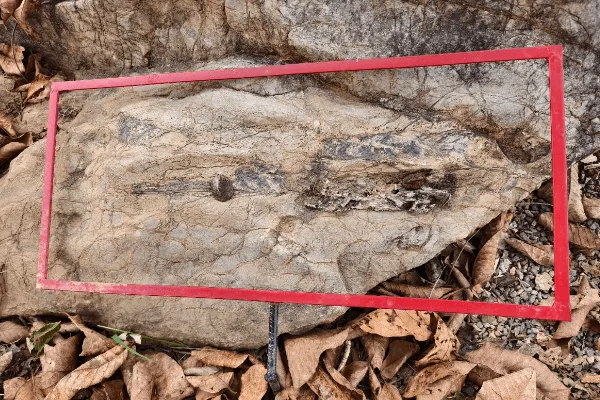
Nautiloids are ancient cephalopods — relatives of today's squid and octopus — that thrived in Earth's seas long before the age of dinosaurs. Their shells, whether coiled or straight, were divided internally into chambered sections. By pumping water and gas in and out of these chambers, nautiloids could control their buoyancy with precision — a principle identical to the ballast tanks of a modern submarine. Of the roughly 2,500 fossil species known to science, only 6 survive today, all belonging to the genus Nautilus. The fossil site at Ban Tha Kradan, Si Sawat District, Kanchanaburi, is among the most significant in Thailand. The fossils are embedded in Middle Ordovician limestone approximately 470 million years old, and belong mainly to three genera: Actinoceras, Armenoceras, and Orthoceras. Actinoceras is the most abundant — specimens typically measure 10–20 cm — and can be seen scattered across the exposed rock surface. Stromatolites (fossilised algae mats) found in the upper rock layers indicate that this area was once an intertidal to subtidal marine environment. In the lower layers, nautiloid fossils lying parallel to the bedding plane point to a moderate- to high-energy sea floor. The largest nautiloid fossils ever discovered approach 10 metres in length, placing these creatures among the most formidable predators of the Early Palaeozoic Era.
Location & Directions
Click the button below to get turn-by-turn directions from Rayaburi Resort to this location.
Get Directions